
Microplastics in Bottled Water: Do They Affect Your Skin?
Microplastics in bottled water: a Gangnam dermatologist explains what studies found, what is known about skin and collagen, and 5 habits that cut exposure.

240,000 particles in 1 liter of bottled water? Five habits that make you take in more microplastics | Dr. Pialnam
From Dr. Hongseok Kim's YouTube channel — Korean audio. It plays muted; tap the video to turn the sound on.

I'm Dr. Hongseok Kim, a board-certified dermatologist with 21 years of practice and the medical director of VOS Dermatology Clinic in Gangnam, Seoul, in front of Dosan Park. At VOS I see every patient myself, from the first consultation to the last treatment.
Microplastics in bottled water became a common question in my clinic after a widely reported study put a number on what is in a single liter. As a Korean dermatologist, what people ask me is not only whether the plastic stays in the body, but whether it can make skin age faster. This page is based on my YouTube video from October 2026; I rewrote it for readers abroad. The video above can be watched with translated captions.
The short answer
- In a 2024 analysis of three commercially sold bottled-water brands, researchers estimated an average of about 240,000 micro- and nanoplastic particles per liter, many of them far smaller than the width of a hair.
- Plastic particles have been reported in blood, placenta and post-mortem tissue, but measurement methods vary and how long they stay or how much leaves the body is still largely unknown.
- Intact skin is a good barrier; a weakened barrier, such as in long-standing atopic dermatitis, is where penetration becomes more of a concern. Lab studies have also shown changes in keratinocytes and fibroblasts, the cells behind the barrier and collagen.
- No method has been proven to flush microplastics out, so the realistic approach is to cut avoidable exposure: do not use plastic hot, for long, or roughly.
How many microplastics are in bottled water?
Short answer: one 2024 study estimated an average of about 240,000 micro- and nanoplastic particles per liter of bottled water.
The researchers analyzed three brands of commercially sold bottled water (in the video at 00:00). If you add up eating, drinking and everything else in a day, the comparison often quoted is that we may take in roughly a credit card's worth of plastic a week. I share that image to make the scale easier to picture, not as a precise measurement.
Microplastics are usually defined as plastic pieces smaller than 5 mm, but recent research is more interested in nanoplastics, which are far smaller than the width of a hair (in the video at 00:50). Larger pieces can simply pass out in stool. Very small particles are different: if the gut barrier is damaged, they may have a chance to reach the rest of the body.
Bottled water is not the only route. Air and dust, packaging, synthetic fibers and plastic cooking tools all shed particles, and squeezing a bottle and opening and closing the cap again and again can release a large number of tiny particles. Purifier water is not automatically clean either: results depend on the type of filter and how well it is maintained, so it is hard to say every particle is removed.
What happens when microplastics enter the body?
Short answer: they have been detected in human tissue, and lab and clinical studies point to inflammation and cell stress, but how long they stay and how much is excreted is still unclear.
A 2022 study reported plastic components in human blood, a 2024 study found polymers in placenta, and a 2025 study analyzing post-mortem tissue, including the brain, drew a lot of attention (in the video at 01:59). Measuring methods and contamination control differ between studies, so the detected amounts should not be taken as fixed figures. What seems clear is that some particles can enter the body.
The first concern is inflammation (in the video at 02:44). Immune cells react to foreign particles, and with repeated exposure that reaction can become the chronic inflammation we worry about. The second is cell stress: in cell experiments, oxidative stress, changes in cell function and changes in barrier function have been observed. In a 2024 New England Journal of Medicine study of people having surgery for carotid artery plaque, those whose plaque contained micro- and nanoplastics had more heart attacks, strokes and deaths afterwards. Those patients already had vascular disease, so this does not show that microplastics cause heart disease, but it suggests they may affect the course of an existing condition.
Can microplastics affect your skin and collagen?
Short answer: healthy skin is a strong barrier, but a damaged barrier changes the picture, and lab studies have shown effects on the cells that build the barrier and collagen.
Your stratum corneum, the outermost layer, is a defensive wall, so plastic touching healthy skin does not simply soak in (in the video at 04:26). The situation changes when the barrier is weak or damaged, and long-standing barrier damage such as atopic dermatitis is where I would be more careful. A 2024 study using several skin models, including human skin, exposed them to fragmented plastic particles and observed signs that small particles could penetrate, along with inflammatory changes. Keeping your barrier in good condition is the first defense, and I explain how in my video on why moisturizer can leave skin drier.
What most people really want to know is whether this touches collagen (in the video at 05:28). A 2025 study exposed keratinocytes to polystyrene and saw changes in the way they mature, the process that should end in a healthy barrier. What interested me more was the effect on dermal fibroblasts, the cells that make collagen and much of the skin's structure: they showed aging-related changes, and expression of a gene linked to type I collagen went down. Think of skin as a building. Collagen is the pillars, and fibroblasts are the repair crew; if the crew cannot work, the structure slowly suffers. Inflammation, barrier function and fibroblast changes are the main pathways of skin aging, and in these studies microplastics touched all three. These are laboratory results, not proof in people, but they are a reason to reduce avoidable exposure rather than to panic.
Five habits that reduce microplastic exposure
Short answer: if you remember one sentence, make it this: do not use plastic hot, for a long time, or roughly.
- Do not heat food in plastic (in the video at 07:10). A 2023 study found very large numbers of micro- and nanoplastic particles released when plastic food containers were overheated in a microwave. Moving hot soup or leftovers into glass or ceramic before heating is a habit anyone can change.
- Stop reusing single-use bottles (in the video at 07:34). Crushing, squeezing, opening the cap many times and leaving a bottle in a hot car all stress the plastic. Drinking from a bottle once is not the main issue; rough, repeated use is.
- Replace deeply scratched plastic cutting boards. Knife marks make the surface rough, and particles can end up on your food.
- Ventilate and clean indoor dust (in the video at 08:19). Rooms full of synthetic fibers, such as clothing or fabric shops, can carry a lot of microplastic in the air. Open windows often, use a circulator if ventilation is poor and keep floors clean.
- Think sensibly about cosmetic containers (in the video at 09:02). Most are plastic and get squeezed, but their materials are more flexible than water bottles and likely shed less. Ingredient names starting with poly- are polymers, not microplastics, so do not treat them as the same thing.
Can you detox microplastics?
Short answer: no method has been proven to remove them, so cutting future exposure is the realistic goal.
I would not pay much attention to microplastic "detox" claims (in the video at 10:02). Personally, when I can, I drink from glass bottles or pour water into a cup, even if it is a little inconvenient. Small, daily habits are what I can control. If you want to look more broadly at what drives your own skin aging, my overview of Korean anti-aging care and my thoughts on why Korean skin is often in good condition are good starting points. At VOS, functional medicine testing looks at metabolic and immune balance behind recurring symptoms and skin aging; it does not measure microplastics, and whether it suits you is a consultation decision. You can also see how visitors found their treatments through our creator experiences at VOS.
Results, timing and recovery vary from person to person, and the right plan for you is decided at an in-person consultation.
Key moments in the video
- 0:00240,000 plastic particles in 1 liter of bottled water?
- 0:50How small are microplastics and nanoplastics?
- 2:00Microplastics detected in the human body
- 2:39What happens when they enter the body?
- 4:17Can microplastics affect your skin?
- 5:19Could they affect collagen and skin aging?
- 6:59Five everyday ways to reduce exposure
Treatments discussed in this video

Real visitors who had it at VOS
Creators and patients who filmed or wrote up their own treatment at VOS.
Keep reading on the blog

Korean Anti Aging: How a Dermatologist Layers Treatments
Korean anti aging, layer by layer: how I combine lifting devices, skin boosters and toxin, what each does, and listed prices. VOS Dermatology, Gangnam.

Why Korean Skin Is So Good: A Seoul Dermatologist's View
Why Korean skin is so good: what genetics explain, which daily habits matter more, what it struggles with, and what visitors can copy. VOS Dermatology, Gangnam
Q&A — what viewers ask Dr. Kim
How many microplastics are in bottled water?
Is filtered or purifier water free of microplastics?
Can microplastics cause wrinkles or skin aging?
Is there a detox that removes microplastics from the body?
Do 'poly-' ingredients in cosmetics mean the product contains microplastics?
Results, swelling and recovery vary from person to person. This page is general information from VOS Dermatology Clinic based on Dr. Kim's video and does not replace an in-person consultation.
About Dr. Hongseok Kim
Dr. Kim performs your Functional Medicine Testing himself — from the first skin analysis to the follow-up check.
Dr. Kim focuses on aesthetic dermatology — skin regeneration, facial contour and healthy ageing — and builds each plan from a close look at the individual patient's skin and goals, aiming for natural, refined results.
At VOS the same specialist is responsible for the whole course of care: diagnosis, the procedure itself and follow-up. An accurate reading of skin structure and how it changes is what makes results more complete and keeps the risk of side effects low.
Credentials & appointments
- Current
- Medical Director, VOS Dermatology Clinic
- Board-certified dermatologist
- Education
- Graduated first in class, medical school
- Academic appointments
- Adjunct Professor, Dept. of Medical Aesthetics, Cheongju University
- Adjunct Professor, Dept. of Beauty Medical Science, Dongguk University
- Professional leadership
- Director, Korean Dermatologist Association (KDA)
- Director, Korean Association for Anti-Aging Dermatology (KAAD)
- Committees
- Academic Committee Member, Korean Dermatological Association
- Information Committee Member, Korean Dermatologist Association (KDA)
- Memberships
- Korean Society for Dermatologic Functional Medicine
- Korean Society for Laser Medicine and Surgery
Brand advisory
- Skincare
- The Scent
- SkinCeuticals
- La Roche-Posay
- AHC
- Bioderma
- Etat Pur
- Injectables
- Juvelook
- Revive
- Lafullen
- Rejuran
- Devices
- Ulthera
- Thermage
- Sofwave
- CoolSculpting
- Mirajet
Lecturing, live demonstrations and brand education — in Korea and across Asia.
- presentations & lectures listed
- 116
- years covered by the list
- 2016–2026
- in 2023, the busiest year listed
- 25
 Lecture
JULIA SUMMIT GLOBALJuvelook Journey — invited lecture · 2025  Conference
APS Korea 2026Aesthetic Plastic Surgery Korea · 2026  Conference
28th KDA Spring ConferenceKorean Dermatologist Association · 2026  Conference
KOREADERMA 2025COEX, Seoul · 2025  Live demo
IMLG 2025Live injection training for international physicians · 2025  Lecture
JULIA SUMMIT ASIA 2025Presentation, Hong Kong · 2025  Live demo
IMLG 2025Faculty & attendees · 2025  Brand event
SkinCeuticalsNext Beauty Code, Taiwan · 2025  Live demo
IMLG 2025Live demonstration, explained step by step · 2025  Brand event
COSRXBrand event, Seoul · 2025
Selected international & major meetings
- 2026
- APS Korea 2026
- 28th KDA Spring Conference
- Invited lecture, Baim Global Jupiter Symposium
- 2025
- JULIA SUMMIT GLOBAL – Juvelook Journey
- JULIA SUMMIT ASIA 2025Hong Kong
- KOREADERMA 2025
- SkinCeuticals: Next Beauty CodeTaiwan
- 9th KDA procedural skills training
- 2024
- AMWC-TDAC Taiwan
- Juvelook Launching Symposium in Taiwan
- KSDS 2nd International Congress Seoul
- 1st Ulthera Focus Group Meeting
Show 2 earlier yearsShow fewer
- 2023
- AMWC Japan
- 41st Annual Meeting, Japanese Society of Aesthetic Dermatology
- ACDS 2023
- MEVOS Dalian
- 2022
- ASLMS (American Society for Laser Medicine & Surgery)
- 13th I-SWAM Indonesia Convention Exhibition
Broadcast
- Morning N — hyperhidrosis and choosing cosmetics
- “Golden time of skin lifespan” (Jul 2021)
- Park Yong-kwan's Radio Show — regular Monday guest
- Good Morning — spring sunlight and skin (Mar 2023)
- Jo Woo-jong's FM Daehaengjin — Dr. Family corner
- Men On Air — summer skin care
Papers & books
- Juvelook Comparative Pain Assessment
- Cosmetic Counseling Expert Course
- Cosmetic Ingredients for Skin Care
Source: VOS Dermatology's official Korean profile of Dr. Kim.
Meet Dr. KimBefore you book, hear it from the doctor himself.
Slide through 17 videos on lifting, skin boosters and travelling for treatment. Korean audio — everything plays right here.
Travel"Flying tomorrow, no bruising or swelling?" Top 3 No-Downtime Lifting (Ultherapy prime,Sofwave,Opus)
LiftingAfter Ulthera & Thermage, What's Next? Dermatologist with 21 Years of RF Experience Breaks It Down!
Skin boostersA Dermatologist with 21 Years of Experience Breaks Down the Skin Booster Family Tree
JuvelookMust-Know Before Getting JuveLook! | What It Can & Can’t Do, Clinic Tips by Dr.DTS
JuvelookPairing Juvlook with This Can Double the Firming Effect (And Ease Nodule Concerns)
JuvelookEverything About Juvelook — Effects, Real Treatment Review, Rejuran Comparison
Skin boostersDoctors Won’t Talk About This Treatment Yet… So I’m Revealing Everything | ECM Skin Booster Q&A
Skin boostersWhy does 'that' super famous skin booster contain 'filler' ingredients?
Skin boostersGOURI Is Korea’s Hottest Skin Booster — But What About the Bruising?
Anti-agingSurface Treatments vs Deep Treatments | Which One Actually Makes You Look Younger?
AftercareDid you just pay a fortune for a dermatology treatment? You'll 100% regret skipping this video.
Dr. KimSorry to my patients... I tried it on myself first (21-Year Derm's Self-Treatment Full Process)
BodyTrapezius Slimming for Sharp Shoulders ✨ How to Get That Clean, Angular Look (Spring/Summer Must)
Travel22-Hour Flight + High-Altitude UV: The One Thing a Dermatologist Used the Whole Time
ResearchScientists Erased a “Mark of Aging” Once Thought Irreversible | A New 2026 Aging Study | Dr. PIALNAM
PoresWhy Your Pores Won’t Shrink | What Actually Works? | Dr. DTS
SkincareWhy Your Expensive Vitamin C Isn’t Working|How to Use It for Better Absorption|Dr. PIALNAM
VOS Shorts
Get to know VOS in seconds — 60-second answers from Dr. Kim to the questions you’d ask in the chair. Everything plays right here.
How to get Juvelook without side effects nodules
How long does Sofwave last?
Boost Your Results with Sofwave!
RE-TOURN! It's Different from Collagen Injections
Juvelook Skin Rejuvenation Effects
How many Ultherapy Prime shots are enough?
Want to look younger!?
Skin Booster: Myths and Facts
Most of Your Allergy Test Results Came Back Positive?! You Might Have OOO Syndrome!
More Isn’t Always Better!? How to Properly Use Moisturizer
Does Snail Cream Actually Contain Snails?
Hands-Free Exercises to Smooth Out Smile Lines
The Secret Habit of People Who Stay Healthy and Live Longer (Worth Millions)
Cleansing oil for sunscreen? Double cleansing? You’ve been doing it all wrong...
Father's Wisdom on Shaving (Secret to Avoiding Cuts)
If nothing you apply stops the dryness
What if you blindly apply too much sunscreen without knowing 'this ingredient'? Your skin will br...
2 Skincare Ingredients a Dermatologist Will Never Use (Be Extra Careful!)
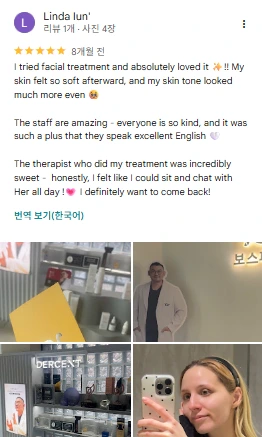
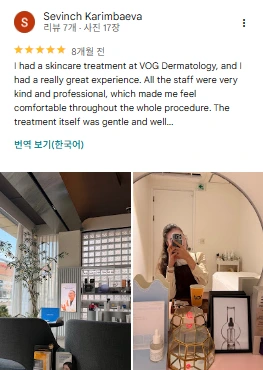
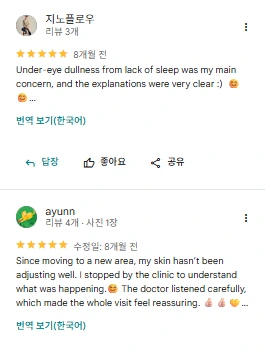
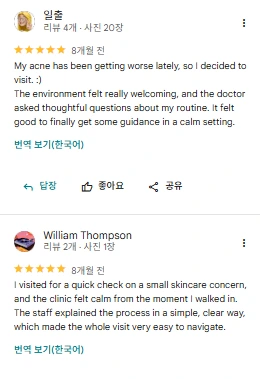
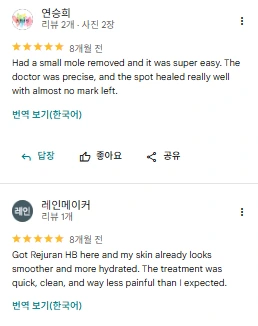
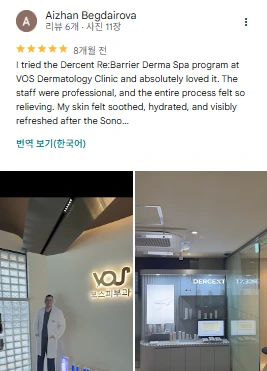
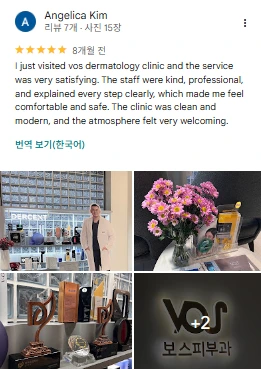
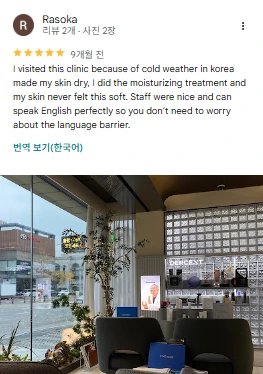
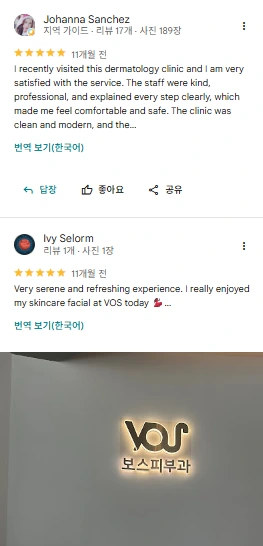
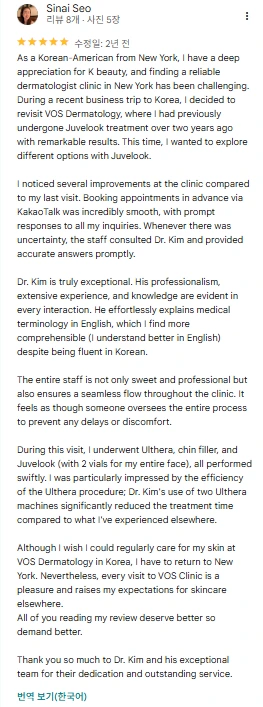
What international patients wrote on Google Maps.
Screenshots of public reviews left on Google — in their own words, unedited. Experiences and results vary from person to person.


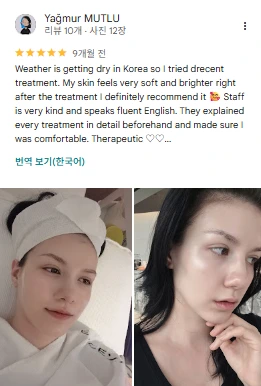
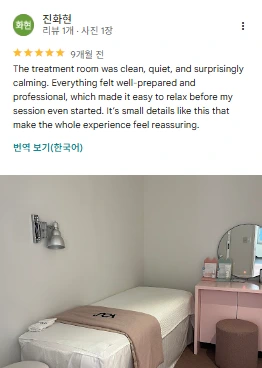
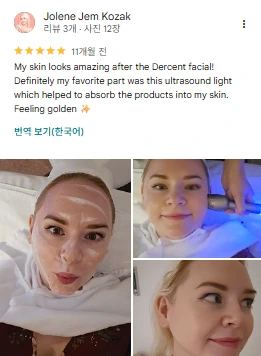
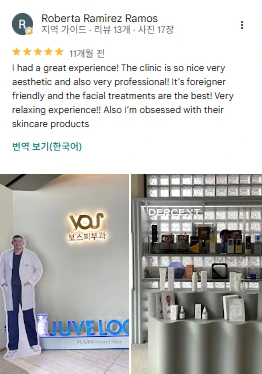
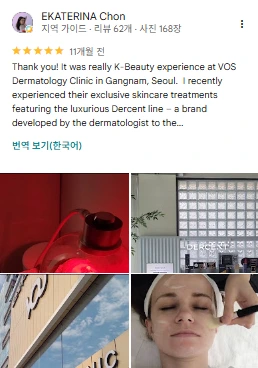
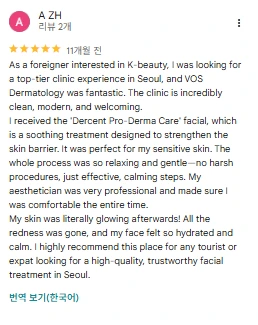
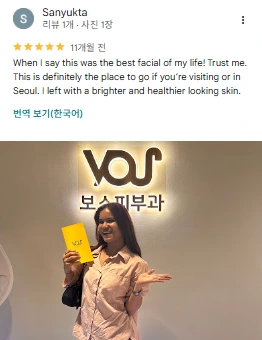
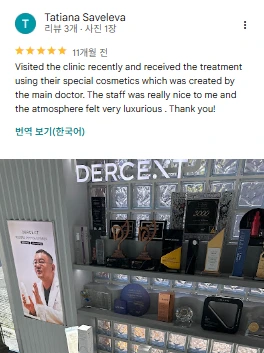
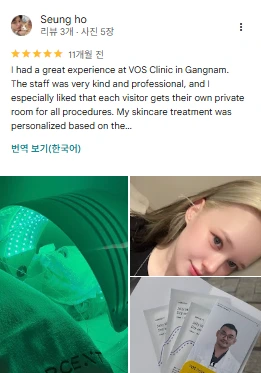

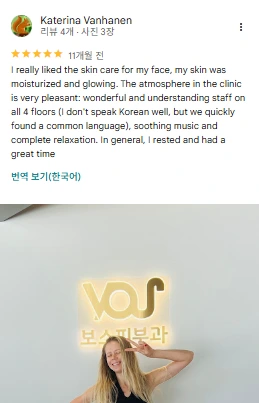


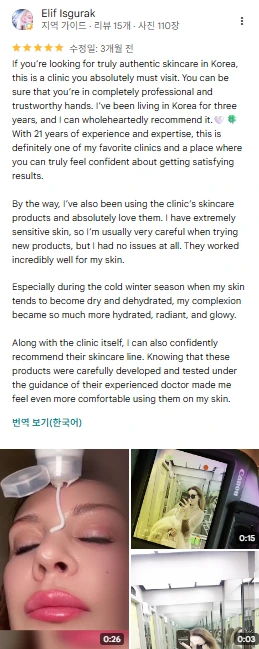
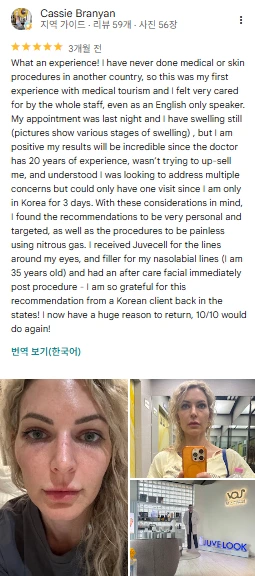
Creators who filmed their treatment at VOS.
Each video comes with Dr. Kim's notes on what was done, why, and the listed price. Opinions are the creators' own; results vary.

Gouri and Belotero Revive in Seoul: A Mother’s Skin Booster Case
Rina brought her mother, visiting from abroad, for a surprise skin treatment. I explain why we paired Gouri, a PCL collagen stimulator, with Belotero Revive, and what to expect.

Juvelook, Botox and Rejuran Lips in Seoul: A Natural Refresh Case
Oxana wanted to refresh her lower face and neck without looking done. I explain her combination of laser, Juvelook, botox and Rejuran in the lips, and why lips can be treated for quality, not volume.
Redness, Pores and Uneven Tone in Seoul: A Real Patient Case
Aizhan came to Seoul with three concerns at once: redness, enlarged pores and uneven tone. I explain how I build one plan for skin like hers, and what it realistically changes.

Skin Botox + ECM Booster in Seoul: A Real Case for Textured Skin
Heli’s skin looked textured and stiff even under makeup. I explain why we paired skin botox with an ECM booster, what ECM actually means, and how the plan was built for her skin.

Skin Botox + Rejuran HB in Korea: A First-Timer’s Real Case
Suhandi was scared of needles and had never had a skin treatment. I explain why we paired skin botox with Rejuran HB, what the session felt like, and when results show.

Thulium Laser, CO₂ Spot Removal and Nuviju in Seoul: A Real Case
Manel stopped posting because she no longer liked her skin. I explain her one-visit plan: a full-face thulium laser, CO₂ for spots and Nuviju for the chin and jawline.

Ultherapy Prime for a Double Chin in Korea: A Real Case
Krisha flew to Seoul to tighten the area under her chin. I explain what Ultherapy Prime does there, when a double chin is fat rather than laxity, and what to expect after.
VOS Dermatology Blog

Korea Juvelook Recovery Program: How Many Days? Cost, Reviews
Korea Juvelook recovery program: bumps often settle in days, collagen takes weeks. Trip days, cost factors and reviews from VOS Dermatology, Gangnam.

Korean Skin Booster Injection Price: What Sets It? Reviews
A Korean skin booster injection price depends on product, mL, sessions and numbing. Dr. Hongseok Kim at VOS Dermatology, Gangnam, explains each factor.

Korean Skin Boosters for Microneedling? Cost, Reviews, Methods
Korean skin boosters for microneedling: how many days of redness to plan, what decides the cost, and which review claims hold up, from VOS Dermatology…

Oligio RF Lifting Korea: Too Early? Cost, Reviews and Methods
Oligio RF lifting Korea: what Oligio XM does, who should skip it, what reviews get wrong and what sets the cost. Send a daylight photo to VOS…

Rejuran Injection Cost Korea: What Counts? Results & Reviews
Rejuran injection cost Korea depends on product, mL, sessions and sedation. Dr. Hongseok Kim of VOS Dermatology, Gangnam, explains each and what to send.

Rejuran Korea Side Effects: How Long? Cost, Reviews, Methods
Rejuran Korea side effects: how long bumps, swelling and bruises last, and how many days to plan. Send a photo and dates on WhatsApp.