
E.P.T.Q. Filler Korea: Is It Safe? Cost, Reviews & Methods
E.P.T.Q. filler Korea: what this Korean HA filler is, its risks, what decides the cost and when to skip it. Send a photo on WhatsApp.


E.P.T.Q. filler Korea: is a Korean-made filler you've seen on a clinic menu a safe thing to have on a short trip, and who helps you if your lips or cheeks look wrong once you're home?
Read this before you book an injection slot between flights.
By the end you'll know what E.P.T.Q. is, what decides the cost of filler in Seoul, what reviews get right and wrong, and which injection methods carry which risks. That should be enough to tell whether filler fits this trip and your budget, or whether it should wait.
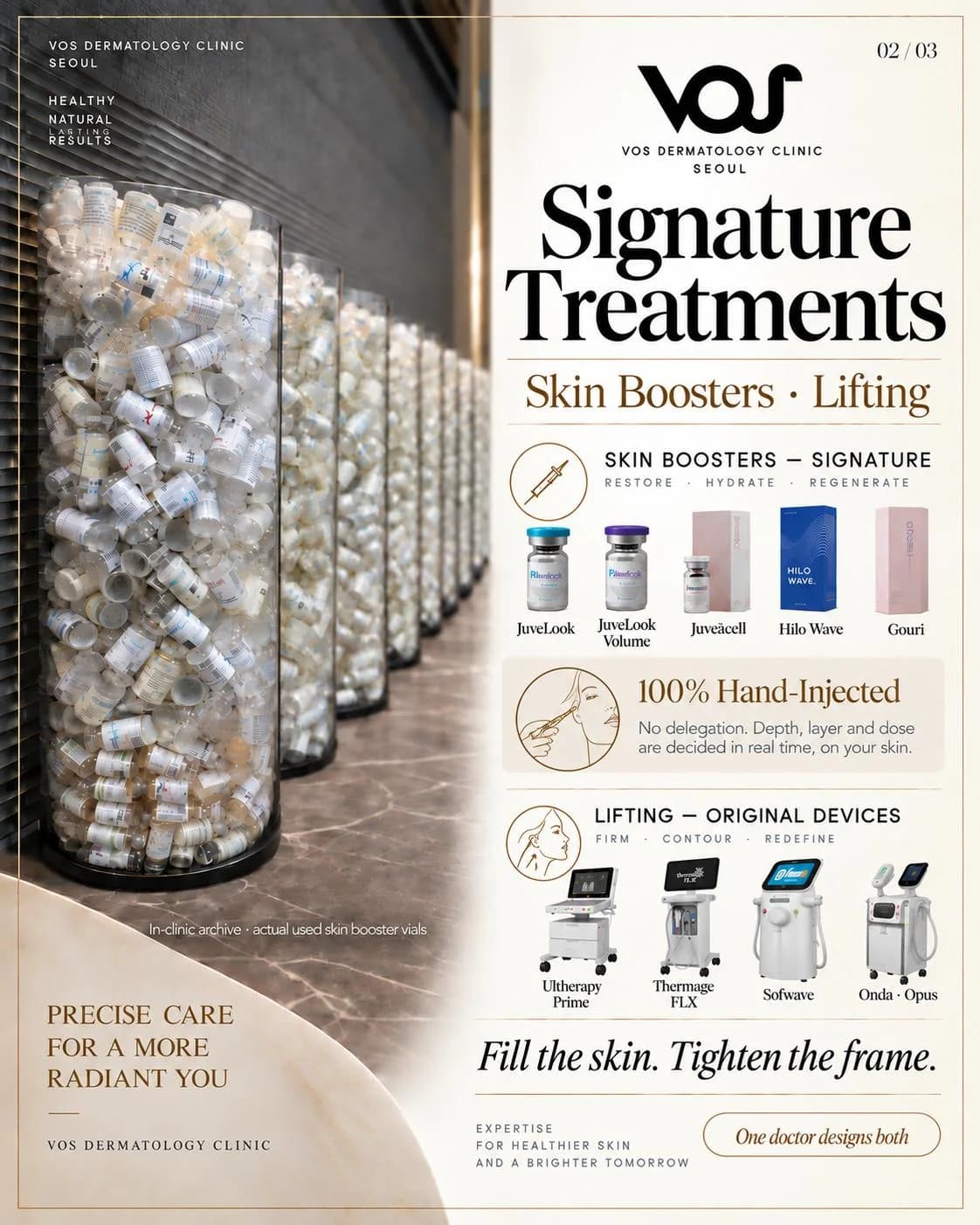
Hello, I'm Dr. Hongseok Kim, a board-certified dermatologist with 21 years of experience and the Medical Director of VOS Dermatology Clinic in Gangnam. I do the consultation and the procedure myself.
My clinic works on three stated principles: correct amount, genuine product, specialist. The person who examines your face is the person who injects it.
I'm writing this because most people choose filler by brand name, while the problems they read about online usually trace back to where the product went, how deep and how much.
E.P.T.Q. is not one of the fillers on my price list, which carries Juvederm and Belotero lines, but the safety questions below apply to any hyaluronic-acid filler you get in Korea.
Send a daylight photo of the area and your travel dates on WhatsAppIf you're not sure filler is even the right fix, send one daylight photo of the area on WhatsApp with your travel dates, and ask the one question that worries you most. You'll get an honest answer about what is realistic, and a quote, before you book.

What is E.P.T.Q. filler, and do I use it?
E.P.T.Q. is made by Jetema, a Korean aesthetics company. A report in the UK trade publication Aesthetics Journal describes the range in three main consistencies: S100 for the superficial dermis, S300 for the mid dermis and S500 for deep subcutaneous injection, with lidocaine, a local anesthetic, in the gel.
Like other hyaluronic-acid fillers, it is a cross-linked gel of a sugar molecule your skin already makes. The US Food and Drug Administration lists hyaluronic acid among the materials used in approved dermal fillers and describes these fillers as temporary, because the body slowly breaks them down.
For anyone looking into E.P.T.Q. filler Korea options, the practical point is that it's one of many Korean hyaluronic-acid brands, and the name alone tells you little about how your face will look afterward.
I don't carry it. The hyaluronic-acid fillers on my list are Juvederm (Volbella, Lift, Voluma, Volux) and Belotero (Soft, Volume, Intense), sorted from soft to firm by where each one belongs. I've compared them in more detail in Korean filler vs Juvederm and Korean filler in Seoul. If you've already had E.P.T.Q. at home, bring the product name and the date, because whoever injects you next needs to know what is already in that area.
Does the filler brand change your risk?
Less than most people expect. Approved hyaluronic-acid fillers differ in particle size, cross-linking and firmness, and that decides where each belongs: a soft gel for fine lines around the mouth, a firm one for a chin or jawline. A firm, deep-layer gel placed in thin skin, or too much of any gel, is what produces the lumps and the overfilled look people photograph and post.
The serious risk, a blocked blood vessel, comes from product entering a vessel or pressing on one. That is a question of anatomy and technique. The American Academy of Dermatology's patient guidance on fillers puts the choice of a trained injector with a working knowledge of facial anatomy at the center of lowering that risk.
Where the brand does matter is authenticity. You're entitled to see the sealed box and the lot sticker before anything is injected, and to take a photo of both for your records. That photo becomes important if you ever need care at home.

Methods: how filler is placed, and why depth matters
Filler goes in through either a fine needle or a blunt-tipped cannula. A needle allows small, precise deposits and is common for lips and fine lines. A cannula slides through tissue and is often chosen for broader areas such as the cheeks, where it may lower the chance of entering a vessel, though no technique removes that chance.
Depth is the second choice. Product placed near the bone supports structure; product placed in the dermis softens lines. That's why E.P.T.Q., Juvederm and Belotero all come in more than one consistency, and why one syringe of a single gel is rarely right for three different areas.
Most hyaluronic-acid fillers now contain lidocaine to numb the area as the injection goes in. If you've ever reacted to a local anesthetic at the dentist, say so before treatment. If needles themselves are the problem, my clinic offers nitrous-oxide sedation, used in over 5,700 cases; ask whether it suits your session.
How I approach filler for someone flying in
Every plan starts with a skin analysis, and I choose the product and amount for your face rather than a package. Every skin is different, so two people asking for the same lip result can leave with different amounts, or with a suggestion to treat a different area first. For every injectable my rule is the exact dose and concentration your skin needs, never more and never less.
Say you're 31, flying in from Toronto for five days, with flat mid-cheeks and a thin upper lip you've wanted fuller for years. I would look at the cheeks first, because support in the mid-face often changes how the lower face reads. I'd be careful with the lip on a short trip: lips tend to swell more than most areas, and a first lip treatment is one I'd keep small. I'd also suggest treating early in your stay, so the first swelling and any bruising happen while you're still in Seoul.
Plan around the calendar too. My clinic is open Monday, Tuesday and Thursday 10:00 to 19:00, Friday until 20:00 and Saturday 10:00 to 16:00, and closed on Wednesdays, Sundays and public holidays. If you land on a Tuesday night, Thursday morning is your first realistic treatment slot.
Doctor's note
If your goal can be met with less, I'll suggest less. Natural, refined change is what I aim for, and with filler, the amount you regret is usually the amount you didn't need. I'd rather you add a little on a later visit than fly home with lips that don't feel like yours.
What can go wrong with lip and face filler?
Risks and side effects to know
The common reactions are temporary. The FDA lists bruising, redness, swelling, pain, tenderness and itching at the injection site among the usual side effects, and for most people they settle within days to about two weeks. Lips usually look their most swollen in the first two days.
Less common problems include small lumps you can feel, a bluish tinge where gel sits too close to the surface in thin skin, infection, and firm nodules that can appear weeks later. Most of these can be treated, and hyaluronic-acid filler can be dissolved with an enzyme called hyaluronidase.
The rare, serious one is vascular occlusion. The FDA's guidance on dermal fillers warns that filler injected into a blood vessel can block blood flow and damage skin, and in rare cases cause vision problems, blindness or stroke. The warning signs are pain out of proportion to the injection, skin turning white and then dusky or mottled, a lacy purple pattern, or any change in your eyesight. When people search for lip filler gone wrong, this is the frightening version, and it's treated as an emergency because speed matters.
As general medical guidance, filler should usually wait if you have:
- a cold sore, acne flare or any infection at the area
- pregnancy or breastfeeding
- a known allergy to lidocaine or to a filler ingredient
- a recent laser, peel or dental work in the same area
- blood thinners or supplements that increase bruising (don't stop prescribed medicine without your own doctor)
If something feels wrong after you're home, act on the signs above without waiting: go to an emergency department and tell them you had hyaluronic-acid filler, where and when. That's why the box and lot photo matters. The US Centers for Disease Control and Prevention's medical tourism guidance also advises arranging follow-up care at home before you travel, so find a local dermatologist you could see if a lump or swelling hasn't settled after a couple of weeks.
Is body, breast or intimate filler worth the trip?
Searches for Korean filler often drift toward breasts, buttocks and intimate areas. My answer to those is no. They aren't on my menu, and in the United States the FDA has not approved dermal fillers for enlarging the breasts or buttocks. Large volumes in the body also raise the stakes of every risk listed above.
The body filler I do offer is narrower: shoulder and collarbone filler for a straighter upper-body line, part of my Better Body Fit menu. I've covered who it suits and how the swelling settles in shoulder filler in Korea.

What do filler reviews get right and wrong?
Forum threads repeat a few claims. Here is how they hold up medically.
"Korean filler brands are lower quality." The country of manufacture tells you very little. Approval by a regulator and an authentic, sealed product are what you can actually check, and you can check them yourself in the treatment room.
"Filler lasts a year," or two, or six months. All of these can be true for different people. How long a hyaluronic-acid filler stays depends on the gel, the area and how much that area moves; lips often soften sooner than a chin or cheek.
"Lip filler gone wrong means a bad brand." Usually it means too much volume, the wrong depth, or repeated top-ups before the earlier product had settled.
"Any filler can be dissolved." True for hyaluronic acid only. Collagen stimulators such as Sculptra (PLLA) and Gouri (PCL), which I also offer, are a different category and can't be reversed with hyaluronidase, so know which one you're getting.
What decides the cost of filler in Seoul?
| Factor | What moves it | What to ask |
|---|---|---|
| Product line | Belotero vs Juvederm; on my list, upgrading from Belotero to Juvederm adds a fee | Which gel suits each area |
| Amount | How many mL each area needs | A realistic mL range for you |
| Number of areas | Lips only vs lips, cheeks and chin | Which area to treat first |
| Extras | Sedation, a combined skin treatment | Whether you need either |
| Days in Seoul | Time for a review before you fly | How many days to leave |
Prices on my list are the same for every nationality. The figure for your face comes from the areas and the amount, so ask on WhatsApp what your areas would come to, and name the areas you have in mind.

Before you message us
Send two things on WhatsApp: a daylight photo of the area from the front and from the side, and the name of any filler you've had before, if you know it. Add the one question you most want answered, for example whether your lip suits a small first treatment on a five-day trip.
When you come in, I examine your skin myself and recommend the product and amount that fit your face, or a different treatment if filler isn't the right tool. Results vary from person to person.
See me explain it on video
I answer the questions patients ask me on camera. The YouTube channel is in Korean with English titles; Instagram and TikTok are for international patients.


Questions readers ask about e.p.t.q. filler korea
Can E.P.T.Q. filler be dissolved if I don't like it?
How soon can I fly after face or lip filler?
Can I have filler on top of E.P.T.Q. I had at home?
Is a needle or a cannula safer for lips?
How long does lip filler last compared with cheek filler?
Results, timing and recovery vary from person to person. This article is general information from VOS Dermatology Clinic and does not replace an in-person consultation. Any prices mentioned are from the clinic’s official price list (KRW, before VAT) and may change.

Korean Filler vs Juvederm: What Differs and What Doesn't
Korean filler vs Juvederm from a dermatologist: how HA gels differ, when brand matters less than placement, and listed filler prices. VOS Dermatology, Gangnam

Korean Filler in Seoul: Products, Areas and Listed Prices
Korean filler explained by a Gangnam dermatologist: which HA gel suits which area, real risks, trip timing and listed price per mL — VOS Dermatology, Gangnam

Shoulder Filler Korea: Shoulder Line, Collarbone and Cost
Shoulder filler Korea guide: how hyaluronic acid refines the shoulder and collarbone line, who it suits, 1–2 week settle and pricing — VOS Dermatology, Gangnam.